When several co-owners jointly own a piece of land, the question of its division often crystallizes tensions. The legal framework of co-ownership allows anyone to request a division at any time, but turning this legal option into a concrete operation requires coordinating urban planning procedures, a contradictory boundary marking, and an agreement on the distribution of lots. Any poorly sequenced step can block the project for months.
Co-ownership agreement and land use: the lever that few projects exploit
Even before discussing surveyors or prior declarations, the first source of conflict among co-owners concerns the use of the property during the preparation period. Who cultivates which plot, who parks where, who pays for the maintenance of the shared fence.
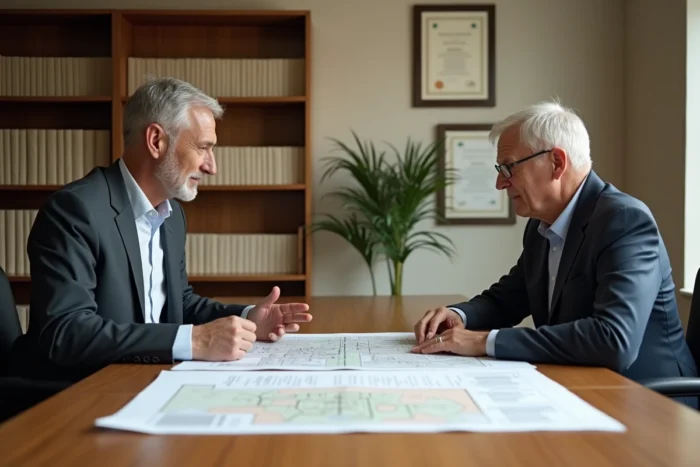
The use of the co-owned property can be arranged by agreement among co-owners, or failing that, by judicial decision. This co-ownership agreement, signed before a notary for a fixed (renewable) duration, sets the rules for enjoyment, management, and decision-making. It does not require immediate division: it stabilizes the situation while the project matures.
In practice, the agreement can stipulate that each co-owner occupies a defined area of the land, that a common representative manages the administrative procedures, and that the costs of the surveyor or development are shared pro rata to the ownership shares. Without this written framework, any expense incurred by a single co-owner can be contested by the others. To fully understand how to divide land in co-ownership, one must incorporate this preliminary step of legal structuring among the parties.
Local Urban Plan and urban planning permits: the timeline that conditions everything else
The feasibility of a parcel division primarily depends on the Local Urban Plan (PLU). The PLU sets the rules for buildability, easements, mandatory access to public roads, and any potential heritage protections. A plot classified as agricultural or natural land cannot be divided into buildable lots, regardless of the agreement among co-owners.
Prior declaration, building permit, or development permit
The type of authorization depends on the nature of the division project:
- A prior declaration, processed in one month, is sufficient for a simple division outside protected sites and without the creation of common areas.
- A building permit is necessary if the division is accompanied by a construction project, with a processing time of two months.
- A development permit is required as soon as the division creates a subdivision (roads, common green spaces), with a three-month processing time, subject to extensions.
These administrative timelines must be included in the shared calendar among co-owners from the outset. Confusing the amicable agreement among co-owners with obtaining operational authorization remains the most frequent mistake. A sales agreement signed among co-owners does not equate to authorization to divide.
Subdivision recognized from the sales agreement
Recent case law has clarified that a division in ownership, and thus the existence of a subdivision, can be considered established as soon as the sales agreement is signed, even before the authentic deed. This interpretation has direct consequences: compliance with the PLU must be verified before signing the agreement, not after. A co-owner who signs without this verification risks a refusal of authorization that jeopardizes the entire arrangement.
Contradictory boundary marking and intervention of the surveyor
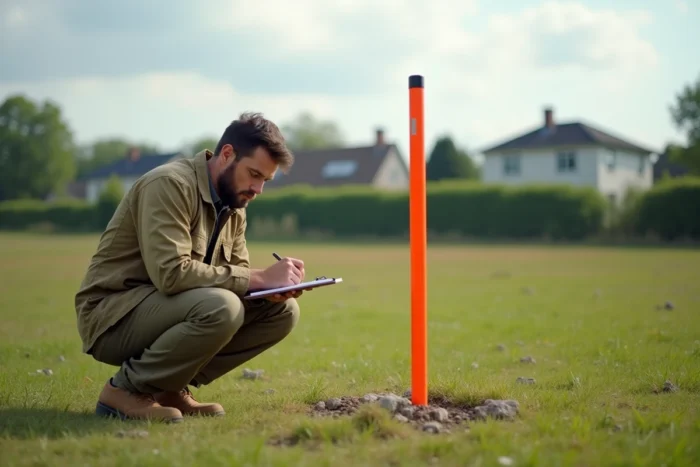
Contradictory boundary marking is the operation that physically establishes the limits between the future lots. It can only be carried out by a surveyor registered with the Order. In the context of co-ownership, boundary marking takes on a particular dimension: all co-owners must be summoned, and each can contest the position of the boundary markers.
The surveyor prepares a boundary marking report signed by all parties, then a modifying document for the cadastral parcel (DMPC) that assigns a unique cadastral number to each new lot. Without a DMPC validated by the cadastre, no separate sale of the lots is possible.
The cost of boundary marking varies according to the area of the land, the number of lots created, and the complexity of the existing boundaries. In co-ownership, the prior agreement should specify who advances these costs and according to what distribution key. Field feedback varies on this point: some notaries recommend an equal sharing, while others suggest a pro rata based on ownership shares, without an imperative rule.

Distribution of lots and exit from co-ownership: avoiding judicial blockage
Once the lots are established and the urban planning authorization obtained, the central question remains: who gets which lot. The allocation can be made by amicable agreement, taking into account the respective ownership shares, the estimated value of each lot, and individual preferences.
Development and unequal value of lots
Not all lots have the same value. A lot facing the road, already connected to utilities, is worth significantly more than a lot at the back of the plot requiring development work (water, electricity, sanitation, access). The costs of development can represent a significant portion of the lot’s value, which skews any distribution based solely on area.
Estimation by a land expert or notary, lot by lot, allows for objectifying the discrepancies. A co-owner receiving a lot of lesser value may receive a compensatory payment from the one receiving the better-located lot.
Amicable or judicial sharing
Amicable sharing, formalized by a notarial deed, remains the least costly route. The sharing tax applies to the net value of the shared properties. However, if a co-owner refuses the proposed sharing, any co-owner can bring the matter before the judicial court to obtain a judicial sharing. The procedure is lengthy, costly, and sometimes results in a sale by auction that satisfies no one.
To reduce this risk, the co-ownership agreement can include a mandatory mediation clause before any judicial filing, as well as a mechanism for priority buyout among co-owners.
Dividing a piece of land in co-ownership is not just a matter of surveyors and administrative forms. The solidity of the project relies on the quality of the initial agreement among co-owners, early verification of urban planning constraints, and a lot-by-lot estimation that incorporates actual development costs. Without these three pillars established in advance, the risk of judicial blockage remains high.