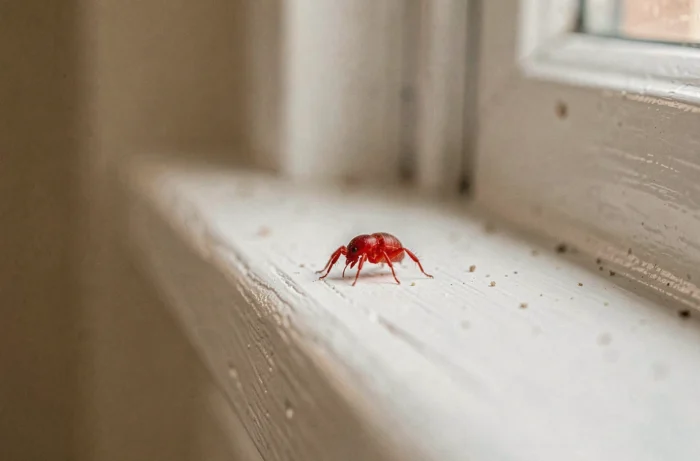
Spotting tiny red dots scurrying along a windowsill or a baseboard often causes disproportionate concern. In the vast majority of cases, a small red insect measuring 1 mm observed inside a house is not an insect in the strict sense, but a mite. Correct identification relies on a few simple morphological and behavioral criteria, provided you know where to look and what to compare.
Red mite or red insect: a confusion that changes everything
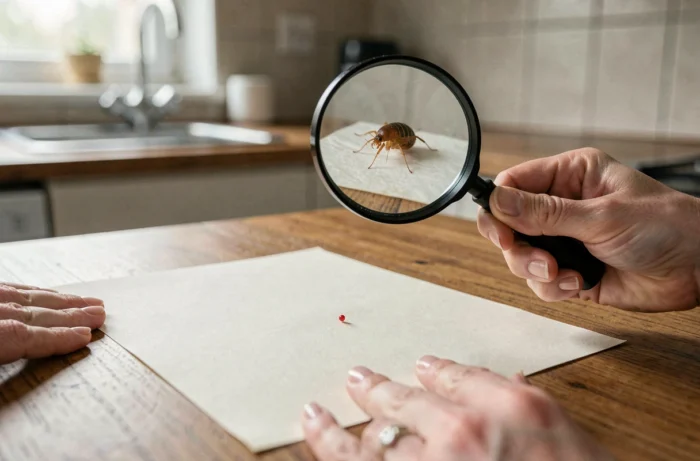
The first instinct when encountering a tiny red creature is to call it an insect. Zoologically, the distinction matters. Insects have six legs, while mites have eight. To the naked eye, on a specimen barely a millimeter long, this detail is hard to verify without a magnifying glass or macro photo.
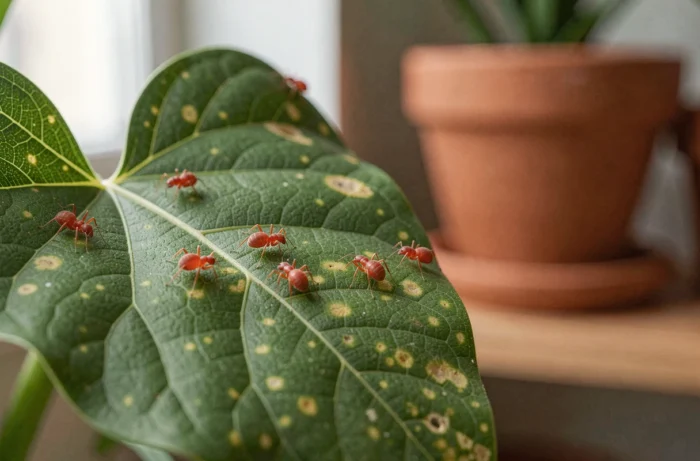
Three categories frequently appear in most domestic reports: concrete mites (Balaustium), clover mites (Bryobia praetiosa), and silky trombidions (Trombidium holosericeum). Spider mites, on the other hand, are mostly observed on indoor plants and are betrayed by the presence of fine silky threads under the leaves, a clue absent in facade mites.
When discovering a small red insect of 1 mm in the house, the priority is to determine whether it comes from the outside (facade, terrace, windowsill) or is associated with a plant. This single question already directs you toward the correct family of mites.
Stain test and presence of webs: two quick sorting criteria
A less mentioned but reliable criterion is based on what the mite leaves behind when crushed. Clover mites leave a clear orange-red stain on a light surface (white paper, fabric). This coloration comes from internal pigments, not blood. The silky trombidion, larger (it can reach the upper limit of a millimeter), leaves a similar mark but in a deeper red, almost purple.
The second criterion concerns the presence or absence of webs. Wall and concrete mites do not weave webs. If you observe fine silky threads under the leaves of your indoor plants, the culprit is very likely a spider mite (red spider of plants), not a facade mite. This distinction leads to different responses: the spider mite indicates a humidity problem around your plants, while the wall mite simply signals a sunny facade.
House orientation and season: why they appear at your place
The available data on reports show a recurring pattern. Small red mites concentrate on facades exposed to direct sunlight and mineral surfaces that store heat: concrete, stone, window sills, terrace tiles.
The season plays a crucial role. Massive appearances occur during warm periods, often during seasonal transitions (late spring, early summer). A specialized forum reports observations of hundreds of thousands of specimens on a thirty-square-meter terrace in the Lyon region, with a complete disappearance on rainy days.
The orientation of your house can thus explain why a neighbor is not affected while your terrace is covered. A south or southwest-facing facade, bordered by low vegetation (lawn, clover, moss), creates ideal conditions.
Factors that favor their presence indoors
These mites do not seek to colonize your home. Their entry is accidental, facilitated by:
- Open windows on the sunny facade, especially in the late afternoon when heated surfaces are at their thermal maximum
- Worn window seals or door thresholds without door sweeps, allowing moving specimens to pass through
- The immediate proximity of low vegetation (clover, grass, wall moss) against the walls of the house, which serves as a population reservoir
Distinguishing a harmless mite from a real problem on your plants
The most common confusion pits the facade mite against the web-spinning spider mite. Both are red, both are tiny. However, their consequences are very different.
The concrete or clover mite does not attack you, your furniture, or your plants. It does not bite, sting, or transmit any diseases. Its only drawback is aesthetic: persistent red stains if crushed on a light wall or textile.
The spider mite, on the other hand, causes visible damage to plants. Leaves turn yellow, dry in patches, and tiny webs appear at the junction of stems. If your indoor plants show these symptoms, the treatment differs: you need to increase the ambient humidity around the foliage and consider cleaning with diluted black soap.
Quick distinction grid
| Criterion | Wall/concrete mite | Spider mite (red spider) |
|---|---|---|
| Location | Facade, windowsill, terrace | Under the leaves of plants |
| Visible web | No | Yes (fine silky threads) |
| Stain upon crushing | Orange-red to purple | Pale red or brown |
| Damage to plants | None | Yellowing, leaf drying |
| Appearance period | Spring-summer, in warm weather | All year round in dry indoors |
Limiting intrusions without resorting to insecticides
Since these mites are beneficial for the garden ecosystem (they feed on the eggs of other arthropods and organic matter), chemical elimination makes no sense. Field reports converge on simple mechanical actions:
- A water jet on the facade and terrace is enough to disperse a colony. The operation can be repeated every few days during peak periods
- Creating a bare soil strip (gravel, sand) about thirty centimeters wide between the vegetation and the wall reduces passage to the house
- Checking the sealing of window seals on the south side and installing door sweeps limits accidental entries
- For indoor plants affected by spider mites, regularly mist the foliage and apply a diluted black soap solution in warm water
Correct identification remains the most useful step. A facade mite entering through the window does not justify any indoor treatment. A spider mite on your plants requires targeted action on the plant, not on the house. Between the two, the stain test and the search for webs allow you to decide in a matter of seconds.