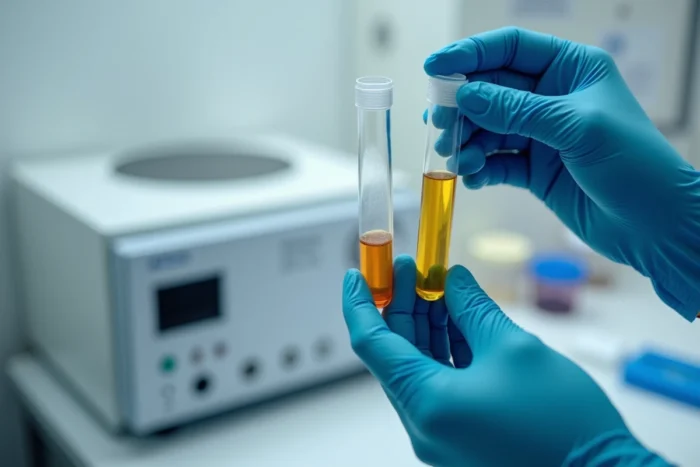
You receive your lipid panel results, and right from the first line, even before the cholesterol or triglyceride numbers, an unusual note appears: “serum appearance: opalescent.” The term is surprising, especially since the laboratory does not always provide a clear explanation. However, this opalescent serum indicates a concrete metabolic situation that goes beyond just excess fats in the blood.
Analytical Interferences: When Opalescent Serum Distorts Test Results
Before discussing cholesterol or triglycerides, it is essential to understand what happens in the laboratory’s automated system. A lipemic serum contains lipid particles in suspension that scatter light. This optical interference can distort several measurements, not just that of triglycerides.
In practice, certain common parameters of the panel (glucose, creatinine, liver enzymes) may show erroneous values when the serum is highly opalescent. The biologist must then resort to clarification techniques such as ultracentrifugation or dilution methods to obtain a reliable result.
It becomes clearer why the mention of “opalescent” in a report is not just a visual curiosity. It signals to the prescribing physician that some results should be interpreted with caution, or even rechecked. When trying to understand the meaning of opalescent serum, this analytical dimension is often underestimated.

Opalescent Serum and Elevated Triglycerides: The Main Cause
A serum that turns milky is primarily due to an excess of circulating triglycerides. Triglyceride-rich lipoproteins (chylomicrons, VLDL) remain suspended and give the serum its characteristic cloudy appearance.
Failure to Fast or True Hypertriglyceridemia
Two situations are clearly distinguished. The first: the sample was taken without adhering to the fasting requirement. A meal high in fats a few hours before the blood draw is enough to make the serum opalescent, without reflecting a lasting metabolic issue. The solution is simple; the test is redone after strict fasting.
The second situation is more concerning. Despite adhering to fasting, the serum remains opalescent. We then face a true hypertriglyceridemia, which requires further evaluation. The triglyceride level often exceeds the threshold considered normal, and LDL particles may also be affected.
Beyond Simple Fat Excess
A clearly lipemic serum while fasting does not only indicate an isolated imbalance of triglycerides. Recent work in medical biology shows that it frequently associates with a broader metabolic syndrome: insulin resistance, visceral obesity, hepatic steatosis. The biologist who observes marked lipemia increasingly recommends an extended evaluation including blood glucose, HbA1c, liver function tests, and TSH.
Cardiovascular Risk and Lipemic Serum: What the Doctor Monitors
An opalescent serum while fasting places the patient in a cardiovascular risk category that warrants a comprehensive evaluation, not just a simple diet prescription.
- The level of LDL cholesterol (the “bad cholesterol”) is recalculated or measured directly, as the Friedewald formula typically used becomes unreliable when triglycerides are very high
- The ratio of total cholesterol to HDL cholesterol is analyzed to assess the level of residual vascular protection
- Family history of cardiovascular disease, stroke, or dyslipidemia guides the urgency of treatment
- Severe hypertriglyceridemia also exposes one to the risk of acute pancreatitis, a serious complication that sometimes justifies rapid management
Screening does not stop at the result of the lipid panel EAL. An opalescent serum while fasting triggers a broader clinical and biological examination, because the risk extends beyond just the cardiovascular aspect.

Concrete Solutions for Opalescent Serum on a Lipid Panel
The management depends on the identified cause and the overall risk level. Three levels of action are distinguished, from the simplest to the most structured.
Check the Conditions of the Sample
The first systematic step: ensure that fasting was properly adhered to for the required duration before the blood draw. A sample redone under the right conditions is sometimes enough to restore a clear serum and normal results. Feedback varies on this point, as some patients believe they are fasting when a sugary drink or dietary supplement was consumed that same morning.
Adjust Diet and Lifestyle
When hypertriglyceridemia is confirmed, hygienic and dietary measures constitute the first treatment. Reducing fast sugars, limiting alcohol, and increasing regular physical activity often allow for a significant decrease in triglyceride levels within a few weeks.
Medication Treatment if Measures Are Insufficient
If high levels persist despite dietary adjustments, or if cardiovascular risk is deemed significant, the doctor may prescribe a lipid-lowering treatment. Fibrates specifically target triglycerides, while statins primarily act on LDL cholesterol. The choice of treatment depends on the complete lipid profile and associated pathologies.
An opalescent serum on a lipid panel is not a mere cosmetic detail of the laboratory. It is a metabolic signal that guides the entire subsequent management: rechecking the dosage, extended evaluation, targeted dietary measures, and sometimes medication treatment. The most effective approach remains to discuss it with your doctor as soon as you receive the results, without waiting for the next routine panel.