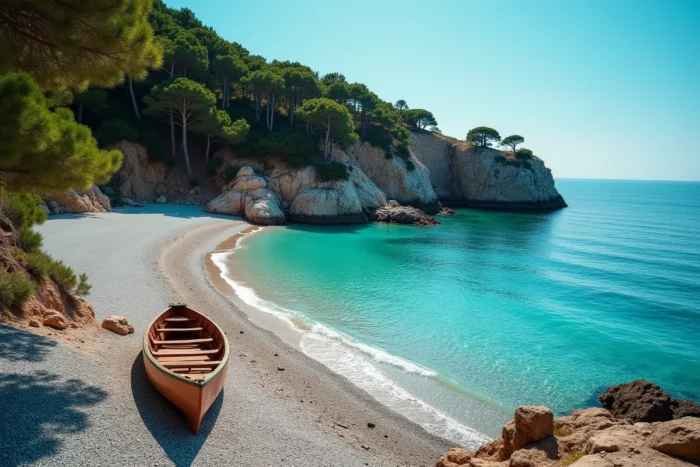
Leaving early in the morning from El Port de la Selva, following the GR-11 under a bright sun, and after more than an hour of walking arriving at a deserted cove bordered by cliffs: this is the reality of Cala Tavallera. This beach in the Cap de Creus natural park, on the Costa Brava, is not earned by chance.
The complete absence of a drivable road and services on site acts as a natural filter against overtourism, even in the middle of August.
Vehicle access prohibited: the constraint that preserves Cala Tavallera
It cannot be repeated enough: no conventional vehicle can reach Cala Tavallera. The path from El Port de la Selva goes through rocky areas where even a 4×4 would struggle, and the regulations of the Cap de Creus natural park strictly prohibit motorized traffic on this section. This prohibition, recently reaffirmed, is not a logistical detail. It is the main mechanism that keeps the cove in a nearly wild state.
Specifically, there are two options to access it: hiking on foot (allow about two hours from the port) or a private boat departing from El Port de la Selva or Cadaqués. The return varies based on the actual difficulty of the trail, as the elevation change remains moderate, but exposure to the sun and the lack of shade on certain sections can make walking strenuous in summer.
For those who wish to explore Cala Tavallera beach under good conditions, leaving before 9 a.m. makes a real difference. You avoid the midday heat and enjoy the cove before the arrival of the few boats.
GR-11 hike to Cala Tavallera: what the trail really offers
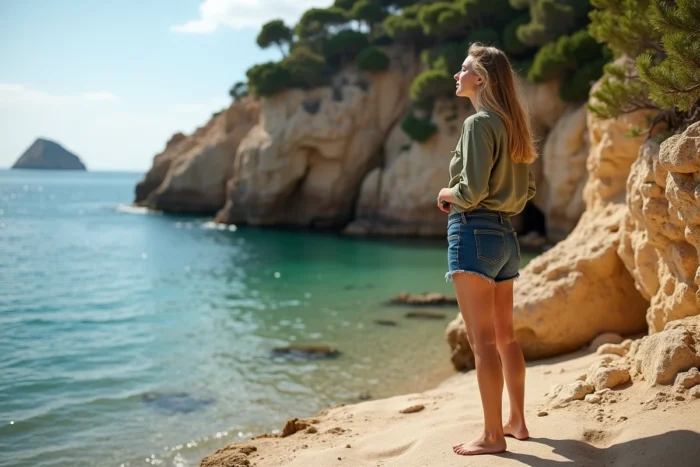
The GR-11, this long-distance hiking trail that crosses the Pyrenees from the Atlantic to the Mediterranean, finds its maritime terminus here. The section leading to Cala Tavallera from El Port de la Selva is not the most technical of the route, but it has its peculiarities.
The detour via Sant Baldiri
Rather than heading straight, it is recommended to follow the direction of Sant Baldiri at the junction marked at the village exit. This detour allows you to pass by the ruins of a Romanesque church, situated there in the middle of nowhere. The church of Sant Baldiri alone justifies the choice of this route.
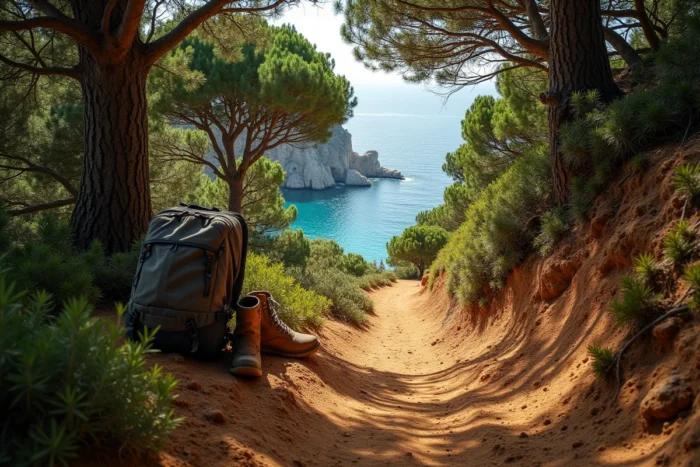
The trail then alternates between exposed rocky sections and short stretches of Mediterranean scrub. There is no water source along the route, no supply point. You carry everything you need, including your waste on the way back.
What you find (and do not find) on site
Cala Tavallera is approximately 135 meters long and about fifteen meters wide. The surface mixes sand and small stones. Here’s what you need to know before settling in:
- No beach services: no sunshade, no shower, no trash can. You are self-sufficient from start to finish
- The waters are clear and suitable for snorkeling, with rocky bottoms visible from the first few meters
- Nudism is practiced, reflecting the locally claimed “cala salvatge” (wild cove) atmosphere
- The bay is bordered by cliffs that partially protect from the wind, but the tramontane can blow strongly and make swimming choppy
Bringing a mask and snorkel completely changes the experience. The underwater landscapes of Cap de Creus are among the richest on the Costa Brava, and this little-frequented cove offers visibility that accessible beaches cannot match.
Cala Tavallera compared to other coves in Cap de Creus
The Cap de Creus natural park is home to several wild coves, and one might wonder why this one deserves particular effort. The answer lies in a rare balance between accessibility and isolation.
Coves like Cala Jugadora or Cala Fredosa are even more difficult to access, to the point of discouraging most hikers. In contrast, Platja del Port de la Selva or the beaches near the village are easy to reach but lose their tranquility by midday in summer. Cala Tavallera occupies a middle ground that makes it accessible without being mundane.
The fact that it is located in a relatively sheltered bay, with a sandy bottom (and not just pebbles like many neighboring coves), also makes it a more comfortable swimming spot. For families with children capable of walking two hours, it is a realistic option, provided they manage their water and sunscreen well.
Preparing for your outing to Cala Tavallera: mistakes to avoid
It is common to see hikers turning back halfway due to lack of preparation. A few points to address before leaving:
- Closed shoes are mandatory on the trail: flip-flops do not grip on the rocks. Change once on the beach
- Sufficient water for the round trip (minimum two liters per person in summer), as there is no water point between El Port de la Selva and the cove
- Enhanced sun protection: the trail is exposed to the south for long stretches, and the reflection on the rocks amplifies exposure
- Trash bag to take all your waste back, in respect of the natural park
The return is via the same path. Plan to leave the beach early enough to avoid walking during the hottest hours, especially between June and September.
Cala Tavallera is not suitable for everyone, and that is precisely what protects it. Its difficult access is not a flaw; it is the reason why its waters remain crystal clear and its sand relatively intact. On the Costa Brava, this type of cove can be counted on one hand.