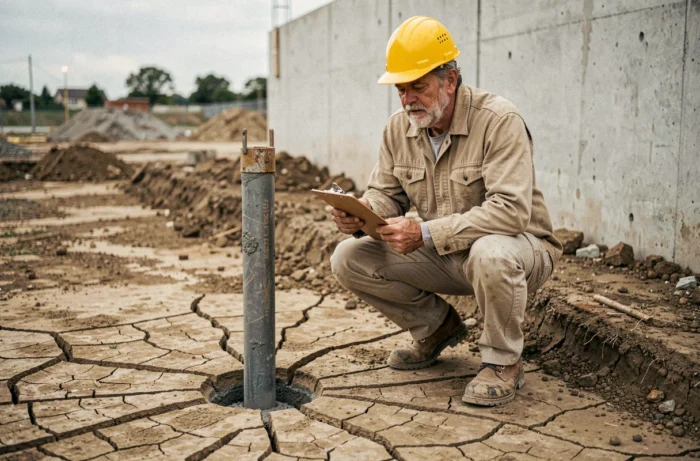
The drought affecting France since the beginning of summer 2026 impacts almost all departments. Clay soils, subjected to increasingly pronounced shrink-swell cycles, are causing structural disorders in a growing number of individual houses.
Cracks in facades, settling of slabs, deformations of load-bearing walls: disasters related to ground movement represent a significant portion of natural disaster declarations. In this context, underpinning with micropiles is among the most frequently prescribed technical responses.
Shrink-swell of clays: what the 2026 drought changes for foundations
The situation, described as exceptional and very early, puts pressure on almost the entire French territory from the beginning of summer 2026.
The phenomenon is not only meteorological. When clay soil loses its water, it shrinks. When it regains water, it swells. This mechanical cycle, known as shrink-swell, exerts differential pressures under the foundations. Houses built on shallow footings, often designed for stable soil, experience uneven settling.
The water restrictions imposed across almost the entire territory in 2026 also affect construction sites and professional uses: limitations on withdrawals, regulation of facade cleaning, reduction of watering. This point, rarely addressed in pages focused on cracked houses, can slow down certain repair interventions that require water for drilling or sealing.
The use of micropiles for underpinning comes precisely when the original foundations can no longer withstand these stresses. The principle involves transferring the building’s loads to a deep, stable layer of soil that is insensitive to surface water variations.
Geotechnical diagnosis before micropiles: G5 and G2 missions
Installing micropiles without prior soil study amounts to treating a symptom without identifying the pathology. Field feedback shows that the quality of the diagnosis directly conditions the relevance and durability of the intervention.
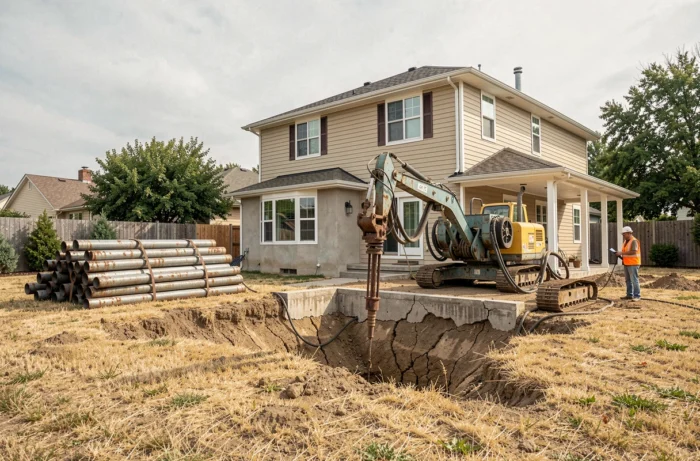
Two geotechnical missions frame this process. The G5 mission identifies the cause of the disorders: nature of the soil, depth of clay layers, presence of water, history of movements. It precedes any technical decision.
The G2 mission, in the design phase, sizes the chosen solution. It determines the number of micropiles needed, their anchoring depth, diameter, and spacing. Without this step, there is a risk of under-sizing the intervention or, conversely, over-sizing an already costly project.
This diagnostic requirement goes beyond simply noting cracks. A cracked wall can result from differential settling, but also from a drainage problem, a leak from an underground network, or an initial construction defect. The G5 mission distinguishes these causes before any intervention.
Micropiles and minipiles: a technical distinction that impacts the site
The term “micropile” actually encompasses several categories of deep foundations. Recent work by Cerema and CSTB introduces a finer distinction between micropiles and minipiles, based primarily on the drilling diameter.
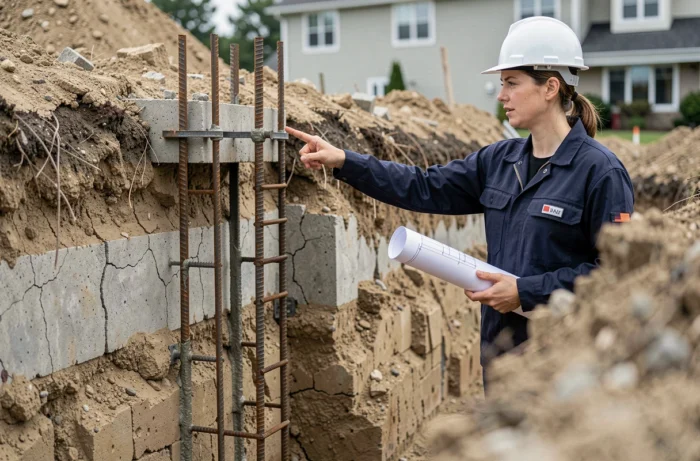
- Micropiles generally have a diameter between 10 and 30 cm. They are drilled at the location of existing foundations and sealed with a cement grout, often reinforced with a metal framework.
- Minipiles, with a smaller diameter, are suitable for configurations where access is restricted (low-ceiling basements, immediate proximity to a party wall).
- The type of micropile chosen (type II, III, or IV according to the standard) depends on the method of implementation and the intended load transfer: lateral friction, point anchorage, or a combination of both.
This finer standardization of practices has a direct consequence on the site. The choice of micropile type conditions the drilling equipment, the duration of the intervention, and the overall budget. A type IV micropile, pressure-sealed, requires heavier equipment than a type II that is simply cased and filled by gravity.
Drilling in dried clay soil
Clay soil during a drought exhibits different mechanical characteristics than wet soil. Its hardness increases, which can complicate drilling and prematurely wear out tools. However, the absence of water in the upper layers reduces the risk of collapse of the drilling hole.
Field feedback varies on the actual impact of drought on the duration of micropile projects. Some companies report extended drilling times, while others believe that the stability of dry ground compensates for this difficulty. The exact nature of the clay and its degree of desiccation remain the determining variables.
Micropiles or resin injection: two distinct logics
In the face of a disaster related to drought, two main families of solutions compete in the underpinning market: micropiles and expansive resin injections. Comparing them directly requires clarifying what each actually does to the soil.
Micropiles bypass the problem of unstable soil. They do not treat it: they ignore it by transferring loads to a deep layer. The structure then rests on a direct mechanical support, independent of surface variations.
Resin injections, on the other hand, act on the soil itself. Expansive resin fills voids, compacts the ground, and can slightly lift a settled structure. This approach is less invasive and often less expensive, but it assumes that the treated soil will remain stable over time.
The debate between the two methods is not just a matter of price. The depth of the load-bearing soil and the amplitude of movements guide the choice. On ground where active clay descends several meters, resins cannot reach the stable layer. Micropiles, however, are sized to reach this load-bearing soil regardless of its depth.
Limitations and points of caution on underpinning projects
Underpinning with micropiles is not a universal solution. Several constraints need to be addressed before launching a project.
- Access around the house must allow for the passage of a drilling rig. In dense urban areas or on sloped terrain, this logistical constraint can exclude certain types of equipment.
- The cost of underpinning with micropiles remains high. Available data does not allow for a reliable range to be set, as there are numerous variables (number of piles, depth, accessibility, region).
- Coordination between the geotechnical expert, the special foundations company, and the insurer often extends deadlines, especially during periods of high claims like the one caused by the current drought.
The sizing relies entirely on the quality of the geotechnical study. A micropile properly anchored in the load-bearing soil sustainably stabilizes a structure. A micropile that is too short or poorly positioned resolves nothing and can worsen disorders by creating a localized hard point.
The increasing frequency of intense drought episodes places underpinning at the center of concerns for homeowners and insurers. Micropiles remain the most robust response when the load-bearing soil is deep, but their effectiveness depends on a rigorous diagnosis and implementation adapted to the actual terrain, not the theoretical one.