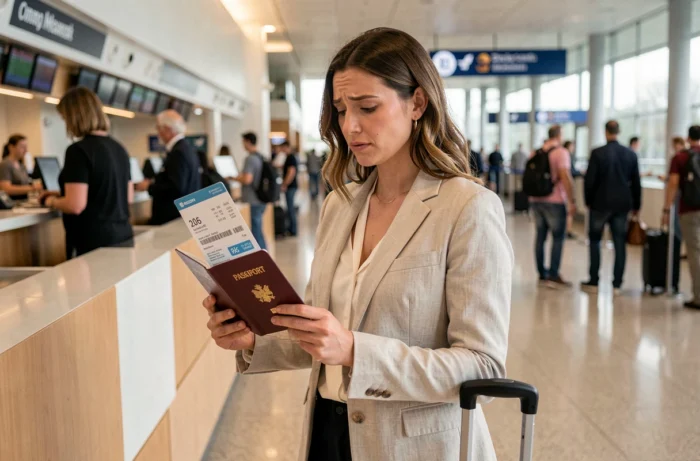
When booking a flight, the question of the name to enter on the ticket arises right from the first field of the form. For a married woman, the choice between maiden name and married name primarily depends on what is stated on the identity document used for travel. The subject seems simple, but there are real areas of ambiguity, and the consequences of an inconsistency can lead to boarding denial.
MRZ strip of the passport: the data that airlines verify
The common reflex is to enter the name that one uses daily. This is a reasoning error. Airlines do not rely on the declared name used orally, but on the machine-readable information, that of the MRZ strip (Machine Readable Zone) located at the bottom of the passport or identity card.
This strip contains only the civil surname, that is, the maiden name. The married name, when mentioned on the document, appears in the visual zone (at the top of the passport), not in the area readable by the automated systems at airports.
This is why most travel professionals recommend booking with the maiden name as it appears on the MRZ. In the case of automated checks at the boarding gate or during an APIS (Advance Passenger Information System), it is this data that is cross-referenced with the booking. A discrepancy between the ticket and the MRZ can trigger enhanced scrutiny or even a blockage.
The choice between using a married name or maiden name on a plane ticket is therefore less about personal preference than about a careful reading of the travel document used.
Using a married name on the passport: what French regulations allow
In France, the married name is legally recognized. A married person can request to have their spouse’s name included on their identity documents, in addition to their maiden name. The passport will then state “Born X, wife of Y” in the visual area.

This mention does not change the content of the MRZ strip. The maiden name remains the only civil name recorded in the French administrative systems. The married name is not intended to replace it; it is added to it.
The practical consequence is as follows: if your passport bears both names, you can technically book with either one. The risk of a problem remains low as long as the name entered corresponds to one of the names printed on the document presented at boarding. However, if you book with your married name and your passport only mentions your maiden name (as in the case of a passport issued before marriage, for example), the inconsistency is glaring.
Name correction after booking: what airlines accept
Not all airlines handle this issue in the same way. Some clearly distinguish three cases:
- The correction of a typo, generally free or low-cost, possible online or by phone
- The update related to a change in civil status (marriage, divorce), accepted upon presentation of official proof, as Etihad or LOT do, for example
- The complete change of passenger, prohibited by the majority of airlines as the plane ticket is nominative and non-transferable
French bee, for example, allows corrections related to the transition from maiden name to married name (or vice versa), but refuses any complete name change of the passenger. The nuance is subtle but decisive.
A common pitfall is to book a ticket several months before the trip and then change passports in the meantime. If the new passport bears a name different from that on the booking, you must contact the airline to request an update. Waiting until the day of departure to report the discrepancy exposes you to a boarding denial.
Traveling outside Europe: align ticket, passport, and electronic authorizations
For a domestic flight in France or an intra-European trip with an identity card, checks often remain visual and the tolerance is greater. The situation changes radically for destinations requiring a passport and an electronic travel authorization.
The name entered on the ESTA, AVE, or ETA must exactly match that of the passport. If you filled out your ESTA with your maiden name and book your flight with your married name, the system may reject the match. The reverse is also true.
The consistency rule applies not only between the ticket and the passport. It covers the entire documentary chain:
- The name on the flight reservation
- The name on the passport (MRZ area)
- The name on the electronic authorization (ESTA, AVE, ETA)
- The name on any residence permit, if required by the destination country
One single inconsistent link in this chain can be enough to trigger enhanced scrutiny at the departure airport or a denial of entry upon arrival.
Details never to include on a plane ticket
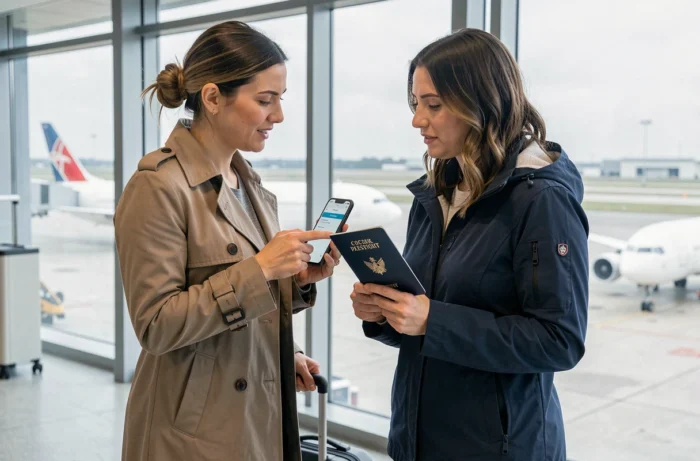
A technical detail frequently mentioned by female travelers: the mentions “wife” or “widow” should never appear on a ticket. These abbreviations, sometimes present on French administrative documents, are not recognized by international reservation systems (GDS). They can cause a rejection of the name or a processing error.
Similarly, hyphens, apostrophes, and special characters present in some compound names are not always handled uniformly by airlines. The prudent approach is to enter the name exactly as it appears on the MRZ strip, without additions, abbreviations, or extra punctuation.
The criterion that always determines is the same: what is printed in the machine-readable zone of your passport constitutes your travel identity. Everything else falls under French administrative usage, perfectly legitimate in daily life, but not necessarily readable by a boarding gate abroad.