
Kems is a team card game where two pairs compete to gather four cards of the same rank and signal their partner with a pre-agreed secret sign before the round. Observation, quick exchanges, and non-verbal communication form the foundation of each game. A simple deck of 52 cards is enough to start a session that can last from a few minutes to over an hour depending on the number of rounds.
The secret signal in Kems: the backbone of each round
Even before dealing the cards, each team isolates itself to choose a discreet signal. This signal means only one thing: “I have my set.” It can be a gesture (scratching the ear, resting the chin on the hand), a word slipped into the conversation, or a change in posture.
A common trap for beginners is to choose a signal that is too obvious. An exaggerated wink or a pronounced cough can be spotted within seconds by the opposing team. Pairs that last several rounds without being unmasked choose signals integrated into their natural behavior: crossing arms, adjusting a strand of hair, or placing their cards on the table in a certain way.
The signal can be changed between rounds. This is even recommended as soon as the opponent seems to have spotted it. Consulting the rules of Kems on Scooporama allows for visualizing concrete examples of signals and their context.

Setup and dealing cards in Kems
Kems is played with four players divided into two teams. Partners sit facing each other around the table, which facilitates reading the signal while complicating observation by opponents placed on either side.
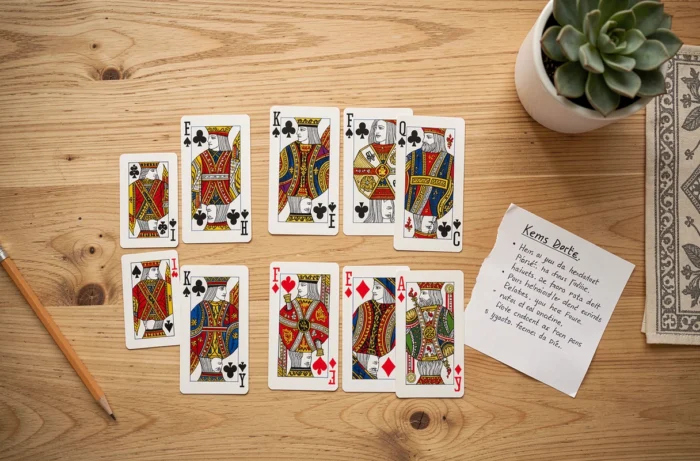
The dealer shuffles the 52-card deck (without jokers) and deals four cards to each player. They then turn four cards face up in the center of the table. These four central cards constitute the common exchange area.
Conducting simultaneous exchanges
Unlike most card games, there are no turns in Kems. All players act at the same time. Each player can take a card from the center and immediately replace it with a card from their hand. The goal is to form a set, which means four cards of the same rank (four Kings, four 7s, four Aces, etc.).
When no one wants to exchange anymore, the dealer removes the four cards from the center and places four new ones. This renewal continues until a player obtains their set or the deck is exhausted.
- Each player always keeps exactly four cards in hand, neither more nor less.
- An exchange consists of placing a card in the center and taking another in the same motion.
- Exchanges are quick: hesitating too long signals to opponents the value you are collecting.
Announcements in Kems: scoring or losing points
The points system is based on two announcements that can occur at any time during exchanges.
The “Kems” announcement
When a player has gathered their set and sends the secret signal, it is their partner who must say “Kems”. The player holding the set cannot announce it themselves. If the partner catches the signal and says the word, the team wins the round and the opposing team receives a penalty letter.
The “Counter-Kems” announcement
A player from the opposing team who spots the signal or suspects a set can announce “Counter-Kems” by pointing to the suspected player. If the designated player indeed has a set, it is the team that called the counter that wins the round. If the player does not have a set, the counter-Kems fails and the team that attempted it receives the penalty.
This mechanic creates constant tension. Accumulating identical cards draws attention, but refraining from exchanging to avoid being spotted slows down the formation of the set.
Score and elimination: the K-E-M-S letter system
With each lost round, the defeated team receives a letter in the order K, then E, then M, then S. The team that accumulates all four letters and forms the word KEMS is eliminated. The complete game is therefore played over several successive rounds.
This system is reminiscent of the basketball game “HORSE”: each mistake brings you closer to elimination with no chance to recover the letters already received. A team trailing K-E can still turn the situation around if they string together winning rounds, as only the losing team of a round receives a letter.
Televised variant with a reduced deck
The show “KEM’S” broadcast on CANAL+ and presented by Eric and Ramzy popularized a variant where only the jack, queen, king, and ace cards are used. This reduced deck speeds up the rounds and makes the game more readable for spectators. This restriction does not appear in the classic rules, which use the full 52 cards.
Common mistakes by beginners in Kems
The first mistake is to constantly fixate on your partner. This behavior immediately alerts the opponents. It is better to scan the table regularly, as if you were monitoring the central cards.
The second is neglecting to observe the opponents. In Kems, defending is as important as attacking. Noticing that an opposing player suddenly stops exchanging cards may indicate that they have just completed their set.
- Do not keep the same signal from one round to the next if the opponent seems to have identified it.
- Avoid collecting only one value from the start: diversify your exchanges to confuse the tracks.
- Agree with your partner on a “abandon” signal to indicate that the set is out of reach and that you should aim for the counter-Kems.
Kems owes its longevity to this balance between reading your partner and monitoring opponents. The simultaneous exchange mechanics prevent downtime, and the signaling system turns each round into a miniature poker game where bluffing is as important as the hand.