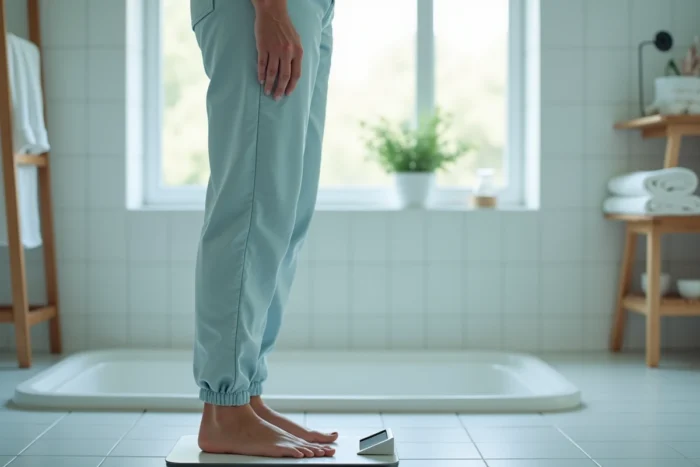
You step on your scale every morning, and the number displayed varies by almost a kilogram from one day to the next. The gross weight doesn’t say much about the actual state of the body, especially after 65. What matters for preventing the loss of autonomy is muscle mass, and that’s precisely what a body composition scale promises to measure. The promise is enticing, but the technical reality deserves some clarifications before trusting the displayed numbers.
Why weight alone is no longer sufficient after 65
A senior can maintain a stable weight for years while gradually losing muscle. Fat replaces muscle tissue, the number on the scale doesn’t change, and the loss of strength goes unnoticed. This phenomenon has a name: sarcopenia.
Have you ever noticed that an elderly relative struggles to get up from a low chair even though their weight hasn’t changed? This is exactly the discrepancy between displayed weight and body composition that makes traditional scales insufficient for seniors.
A body composition scale attempts to address this issue by sending an imperceptible electrical current through the body. Muscle tissues, rich in water, conduct this current better than fat. The device deduces an estimate of the distribution between muscle mass, fat mass, and body water. When considering the reliability of body composition scales, it’s essential to understand this distinction between direct weight measurement (reliable) and estimation of body composition (approximate).

Muscle mass and body composition scale: what the scale really measures
The principle of bioelectrical impedance analysis (BIA) relies on an indirect calculation. The device does not “see” your muscles. It measures the body’s resistance to the flow of current, then applies an algorithm that correlates this data with your age, height, and sex.
The displayed result thus depends as much on the manufacturer’s algorithm as on the physical measurement itself. Two different scales, used at the same time on the same person, can yield significantly different muscle mass values.
Factors that skew results in seniors
Hydration plays a major role. However, elderly individuals are often in a state of mild chronic dehydration. Less water in the body means altered electrical resistance, and therefore a potentially skewed estimate of muscle mass.
Other elements disrupt the measurement:
- Water retention related to certain medications (diuretics, corticosteroids) alters tissue conductivity from one weighing to the next
- The temperature of the skin and feet, often cooler in seniors, affects contact with the scale’s electrodes
- The time of day changes the results: a measurement after breakfast and a measurement on an empty stomach will not yield the same body composition values
These variations do not challenge the principle of the device, but they impose a discipline of use that few manuals explain clearly.
Tracking trends rather than absolute values: the right method for seniors
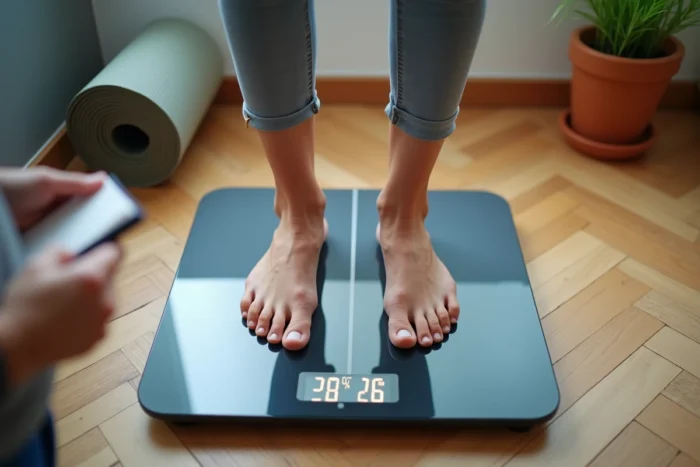
Recent comparisons of connected scales converge on one point: the absolute value of muscle mass displayed is unreliable, but the trend over several weeks is more reliable. In plain terms, if your scale shows 28 kg of muscle mass, this number may be far from the reality measured by a medical examination (DEXA). However, if this number drops from 28 to 25 kg over three months, the loss is real and should raise alarms.
For trend tracking to work, it is crucial to minimize extraneous variables. Practically, this means:
- Weighing yourself always at the same time, under the same conditions (morning on an empty stomach is the most stable time)
- Using the same scale, on the same hard and flat surface (tile, not a carpet)
- Keeping feet clean and dry for good contact with the electrodes
- Not interpreting a single isolated measurement, but looking at the trend over a minimum of four to six weeks
Connected scales with senior mode: a real practical gain
Recent models offer a simplified display mode designed for elderly individuals. Fewer indicators displayed simultaneously, readable trend curves on a large screen, sometimes a single button to start the measurement. This is not a gimmick: reducing complexity of use decreases handling errors, thereby improving the consistency of data over time.
Some devices intentionally limit the number of visible metrics to avoid confusion. Instead of displaying fat mass, bone mass, water percentage, and BMI simultaneously, they highlight weight and muscle mass, with an arrow indicating whether the trend is stable, increasing, or decreasing.
Limitations of the body composition scale compared to medical diagnosis
A home scale, no matter how sophisticated, does not replace a body composition assessment conducted in a medical setting. Dual-energy X-ray absorptiometry (DEXA) remains the gold standard for accurately measuring muscle mass. Doctors use it to diagnose sarcopenia according to validated thresholds.
The body composition scale is positioned upstream: it is a home monitoring tool, not a diagnostic instrument. Its role is to detect a drift, a warning signal that justifies a consultation later on. Waiting for a healthcare professional to notice muscle loss during an annual appointment is often too late to act effectively.
For a senior living alone or whose medical follow-up is spaced out, a connected body composition scale can transmit data to a relative or caregiver. This remote sharing function is likely more useful than the precision of the number itself.
Monitoring muscle mass after 65 deserves more than a distracted glance at the morning number. With rigorous use and calibrated expectations, the body composition scale becomes a concrete prevention tool, provided one reads a trend rather than a number.