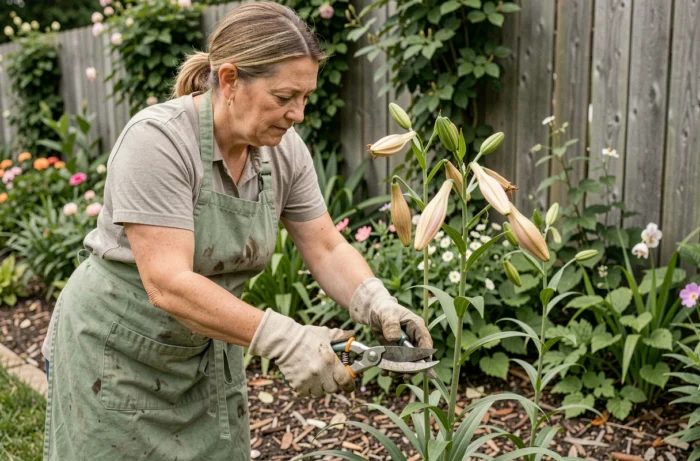
The regrowth of lilies after pruning relies on a sequence of precise actions, the order and timing of which directly influence the quality of the subsequent bloom. Drainage of the substrate, timing of the cut, type of fertilizer, winter protection: each parameter affects the bulb’s ability to replenish its reserves. Comparing these factors allows us to measure which have the most impact on regrowth.
Factors for lily regrowth after flowering: comparative table
Specialized sources highlight four main levers. Their relative impact on bulb reconstitution varies depending on whether it is a lily in the ground or in a pot.
| Factor | Lily in the ground | Lily in a pot |
|---|---|---|
| Soil or substrate drainage | Light, well-drained soil, never waterlogged | New substrate with a drainage layer, increased risk of stagnation |
| Cutting after flowering | Only remove wilted flowers, keep the green stem | Same principle, but easier access for a clean cut |
| Fertilization | Special bulb fertilizer (phosphorus/potassium), avoid excess nitrogen | More frequent application as the substrate quickly depletes in pots |
| Winter protection | Sufficient mulching in most regions | Bring the pot indoors to prevent freezing or insulate with a cover |
This table highlights a clear difference between the two situations. In the ground, natural drainage and the volume of soil limit errors. In pots, each parameter requires closer attention, which explains why many bulbs do not regrow the following season.
To delve deeper into each step, you will find gardening tips on D Kom Déco that detail the pruning schedule and the actions to adapt according to the variety.
Lily foliage after pruning: why the cutting schedule changes everything
The most common reflex after flowering is to cut back the entire plant. This is precisely the action that compromises regrowth. The foliage must remain in place until it has completely yellowed, as it continues to photosynthesize and transfer energy to the bulb.
Cutting the green stem too early deprives the bulb of its recharging source. The only part to be removed immediately after flowering is the wilted flower, or even the seed capsule that forms at its top. This capsule, if left, mobilizes resources that the bulb could store.
Identifying the right time to cut back the stem
The reliable signal is the complete yellowing of the foliage, which generally occurs several weeks after the end of flowering. As long as green parts remain on the stem, it is still feeding the bulb. Once the foliage is completely dry, the stem can be cut a few centimeters above the ground without any risk.
In the ground, this waiting period is easy to manage: simply plant low perennials around the lilies to hide the yellowing foliage. In pots, the appearance is less tolerated, but the principle remains the same. Removing the green foliage reduces flowering in the following season.
Fertilizer for lily bulbs: phosphorus, potassium, and the nitrogen trap
Post-flowering fertilization is the second lever identified in the table. The type of fertilizer used directly steers regrowth towards foliage or flowers.
- A fertilizer rich in phosphorus and potassium promotes the buildup of reserves in the bulb and prepares for the next bloom.
- Excess nitrogen stimulates leaf production at the expense of flower buds, resulting in a vigorous plant but one that blooms little the following season.
- A fertilizer labeled “special for bulbs” generally has the right ratio, with a phosphorus-potassium dominance.
Avoiding excessive nitrogen after flowering is a simple rule that makes the difference between a lily that blooms again and one that produces only foliage. The application is done after cutting the wilted flowers, while the foliage is still green and active.
Potted lilies after flowering: repotting, resting, and regrowth
This is the least documented scenario among competitors, while potted lilies represent a significant share of regrowth failures. The limited volume of substrate concentrates three simultaneous risks: nutrient depletion, excess moisture, and exposure to frost.
When and how to repot a lily bulb
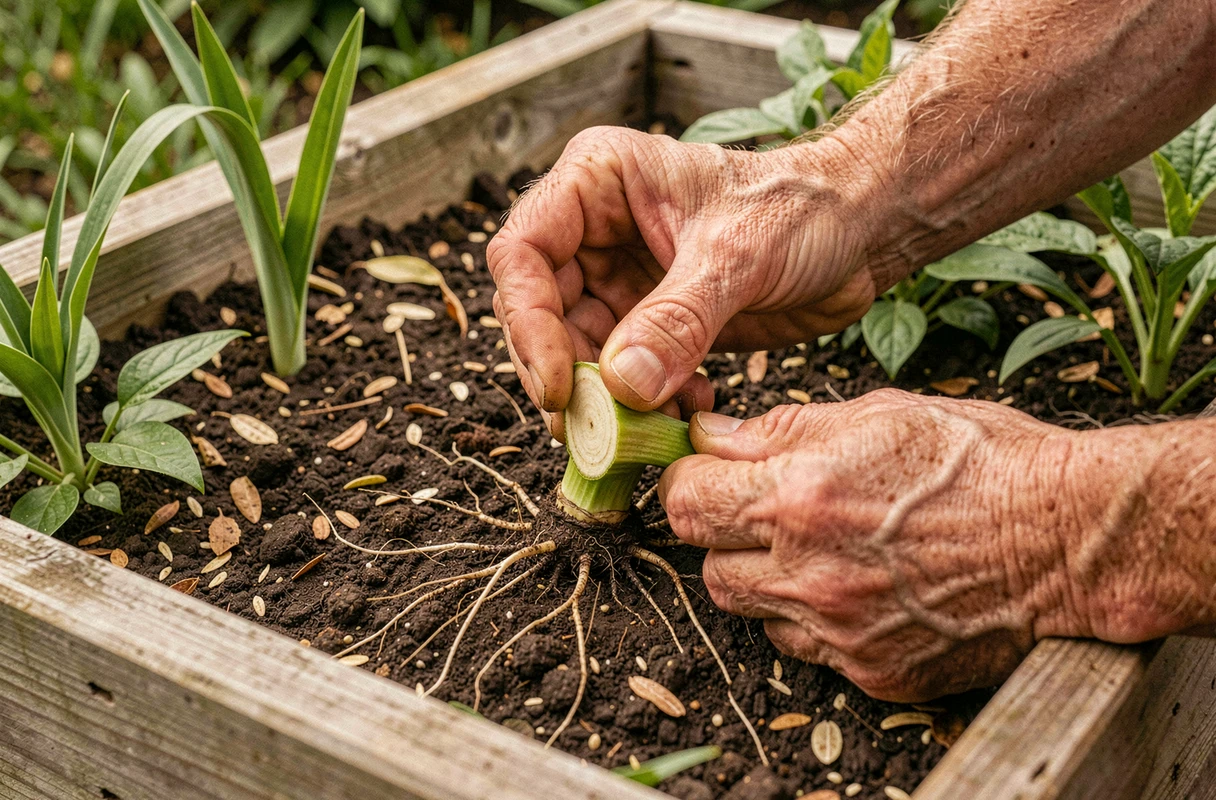
Repotting ideally occurs after the foliage has completely yellowed. The bulb is then dormant and can withstand handling. A new, light, and well-drained substrate replaces the old potting soil that has been depleted by the growing season.
- Place a layer of clay balls or gravel at the bottom of the pot to avoid any water stagnation in contact with the bulb.
- Use a soil-sand mixture (or soil-perlite) that allows water to drain quickly.
- Plant the bulb at a depth equivalent to two to three times its height.
- Do not water immediately after repotting: the dormant bulb does not need moisture.
Winter protection for potted lilies
A bulb in the ground benefits from the thermal inertia of the soil. In pots, the substrate freezes much faster. Prolonged frost destroys the roots and the bulb’s basal plate, making any regrowth impossible.
The most effective solution is to bring the pot into a cool, frost-free, but unheated space (garage, cellar, unheated veranda). The bulb needs this period of moderate cold to vernalize properly. A place that is too warm prevents the breaking of dormancy in spring.
If the pot must remain outside, a winter cover wrapped around the container and a thick layer of mulch on the surface limit damage, without guaranteeing total protection in case of severe frost.

Watering lilies after pruning: drainage as a non-negotiable condition
Overwatering destroys more bulbs than lack of water. After flowering, the water needs of the lily gradually decrease as the foliage yellows. A constantly moist soil or substrate causes bulb rot.
In the ground, naturally well-drained soil (sandy, loamy) evacuates excess water. Clay soils pose a problem: they retain moisture around the bulb for days. In this case, planting the bulb on a bed of gravel or raising the planting area significantly improves drainage.
In pots, control is more direct but requires consistency. After cutting the wilted flowers, reducing watering to once a week is sufficient as long as the foliage is green. Once the foliage is dry and the stem is cut, stop watering until the following spring.
Ultimately, the regrowth of lilies hinges on a logical sequence: cut only what is wilted, nourish with the right fertilizer, let the foliage work, and then protect the bulb from cold and stagnant water. Repotting in pots, often neglected, remains the action that can tip the results from one season to the next.