
Have you ever noticed that after a period of work overload, even weekends are no longer enough to recover? Sleep becomes light, decisions seem blurry, and a diffuse fatigue sets in for no apparent reason. Personal development coaching starts from this common observation to offer a structured framework. Not a miracle solution, but a gradual work on the mechanisms that generate this imbalance.
Personal Development Coaching: A Profession Without a State Diploma
Before seeking support, one fact deserves your attention: the profession of coach remains unregulated in France. No state diploma or administrative authorization is required to practice. In practical terms, anyone can declare themselves a personal development coach tomorrow morning.
This does not mean that all practitioners are equal. Some follow certified training recognized by professional federations. Others rely on approaches derived from cognitive and behavioral therapies (CBT), positive psychology, or sophrology.
To distinguish serious support from approximate services, check three elements: the training followed by the practitioner, their ethical framework (supervision, confidentiality), and their ability to set clear boundaries between coaching and psychotherapy. A competent coach refers to a health professional when the situation requires it.
Organizations like Espace Renaitre offer support that combines several approaches tailored to individual needs, allowing work on stress, limiting beliefs, or self-confidence within a coherent framework.
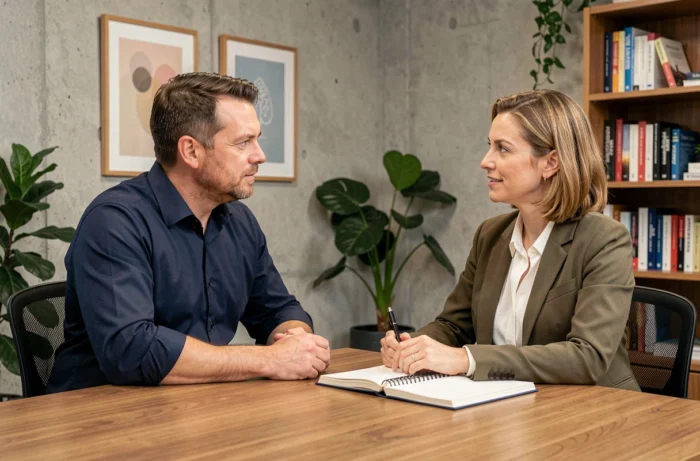
Stress Management and Limiting Beliefs: Two Concrete Levers
Personal development covers a broad field. To clarify things, let’s focus on two axes that recur in most support sessions.
Stress as a Signal, Not an Enemy
Stress management is not about eliminating it. Stress is a useful physiological signal: it prepares the body to react to a constraint. The problem arises when this signal remains activated permanently, without breaks or recovery.
Support targets the specific triggers of chronic stress. For example, a person who procrastinates on their work tasks is not necessarily lazy. They may be unconsciously avoiding a situation perceived as threatening (judgment from a superior, fear of making a mistake).
The work then consists of identifying this pattern and implementing gradual actions. We do not ask to “think positively.” We modify, step by step, the automatic response to the stressful situation.
Beliefs That Hold You Back Without You Seeing Them
Have you ever turned down an opportunity by telling yourself “I’m not capable” or “that’s not for me”? These internal phrases, repeated since childhood, act as filters. They guide decisions, relationships, and life choices, often without us being aware of it.
Identifying a limiting belief is the first step to disarming it. A coach helps to articulate the automatic thought, confront it with facts, and then test an alternative behavior. This process, inspired by CBT, produces measurable results on self-confidence and decision-making.
Work-Life Balance: Beyond the To-Do List
Many people seek personal development support because they feel an imbalance between their professional and personal lives. The trap would be to reduce this problem to a question of time management.
Balance is not achieved by adding “well-being” slots to an overloaded schedule. It requires clarifying one’s values, meaning what truly matters in daily life, and checking if the actions taken each day align with those values.

Let’s take a simple example. A person claims that physical health is their priority. Looking at their week, they realize they have no time for physical activity, eat in front of their screen, and sleep less than six hours. The gap between the stated value and actual behavior creates a low-grade tension, generating stress and guilt.
The role of support is to make this gap visible and then build realistic adjustments. Not an ideal life plan on glossy paper, but gradual modifications that are sustainable over time.
Choosing the Right Support: Selection Criteria
Given the diversity of offerings, here are the criteria that allow for effective orientation:
- The format of the sessions: individual or group, in-person or virtual. Individual coaching is suitable for specific personal issues. Group workshops work better for developing relational or communication skills.
- The duration of the support: work on stress management can yield results in a few sessions. In-depth work on beliefs or relational patterns generally requires several months.
- The practitioner’s posture: a good coach asks questions rather than providing answers. They do not create dependency. Their goal is to make you autonomous in your ability to step back and act.
- The financial framework: coaching is not eligible for CPF as such. It can only be funded if it is linked to an eligible action such as a skills assessment or a certification registered with the RNCP. Inquire before committing.
One last point to keep in mind: personal development is not a destination. It is a process that evolves with life phases, professional transitions, and personal events. The most useful support is the one that provides you with lasting tools, not the one that keeps you in ongoing follow-up. The success criterion is simple: at the end of the journey, you know better how to identify your needs and respond to them by yourself.