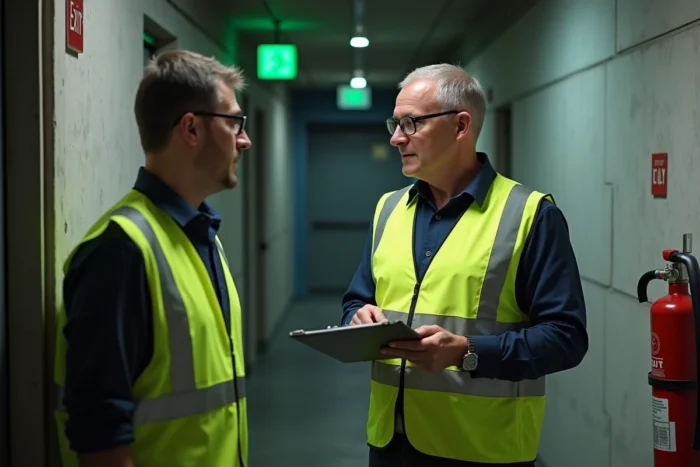
When preparing for the opening or renovation of a performance venue, the first obstacle is not the choice of seating or stage design. It is the fire safety file, the ERP classification, and the visits from the safety commission. Every venue operator in France must navigate a dense regulatory framework, structured around the decree of June 25, 1980, the Building Code, and specific provisions for type L establishments.
Fire behavior of furniture: what changes concretely from 2026
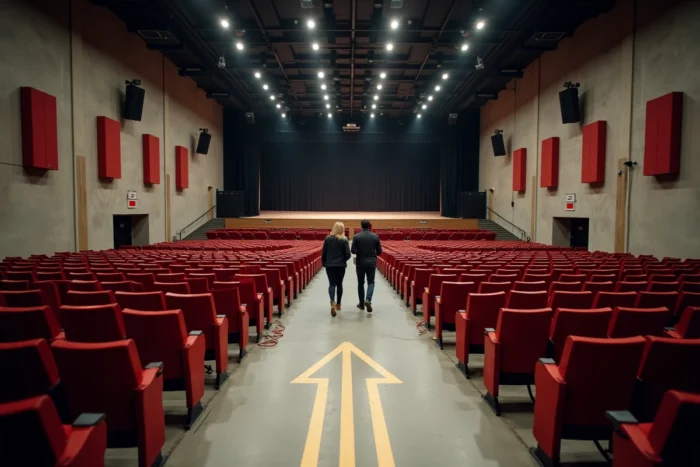
General content rarely addresses furniture. Yet, it is a frequent sticking point during inspections. Type L performance venues remain governed by the decree of June 25, 1980, but updates that come into effect on January 1, 2026 have tightened the requirements regarding the fire behavior of row seating: padding, covering, minimum wood thickness.
In practice, a chair that passed tests a few years ago may no longer be compliant. Manufacturers are now incorporating these new constraints into their specifications, and the compliance files for new or renovated venues must explicitly refer to them.
For operators, this means one thing: before placing any furniture order, check the manufacturer’s technical sheet and its compliance with the latest amendments to the decree. A discrepancy on this point can block the favorable opinion of the safety commission. All applicable texts regarding regulation and safety of performance venues should be consulted prior to any project.
ERP type L classification: categories and ground obligations
A performance venue, a cinema, a circus: all fall under type L in the ERP classification. This letter determines the applicable safety provisions, from the fire safety system (SSI) to evacuation and smoke extraction rules.
Establishment category and audience thresholds
The category (from 1 to 5) depends on the seating capacity. Small venues, accommodating fewer than a few hundred people, often fall under the fifth category. The obligations are lighter there, but not nonexistent: emergency lighting, fire extinguishers, and compliant exits remain required.
For first-category venues, we move to another level. The required SSI is stricter, and safety functions multiply:
- Compartmentalization to limit the spread of fire between areas of the venue
- Mechanical or natural smoke extraction sized according to the volume of the venue and the number of spectators
- Automatic dissemination of the evacuation signal coupled with the management of emergency exits
- Shutdown of certain technical installations (ventilation, non-priority power supply)
The classification into categories also conditions the frequency of visits from the safety commission. An unfavorable opinion results in administrative closure until compliance is achieved.
Article GN 10: the trap of existing venues
Sometimes it is believed that an old venue, already in operation, escapes new standards. Article GN 10 of the decree of June 25, 1980, establishes a clear principle: except for specific provisions, the regulations applicable to new constructions do not automatically apply to existing venues. However, heavy renovations trigger the application of new regulations, in whole or in part.
In practice, a renovation of the stage area or an increase in capacity may require a revision of the SSI, smoke extraction, and circulation paths. Responses on this point vary according to departmental commissions, but the risk of reclassification exists with each submission of a modification permit.
Evacuation and emergency lighting: recurring errors in operation
On the ground, the most frequent non-compliances do not concern the building’s structure. They relate to daily operations: blocked emergency exits, faulty emergency lighting, signage obscured by decorations.
Emergency lighting must allow for evacuation even in the event of a total power outage. Autonomous emergency lighting units (BAES) must be tested regularly, and each test recorded in the safety register. A non-functional BAES on the night of a performance is grounds for a report in the event of an unannounced inspection.
Circulation and exits: sizing for actual flow
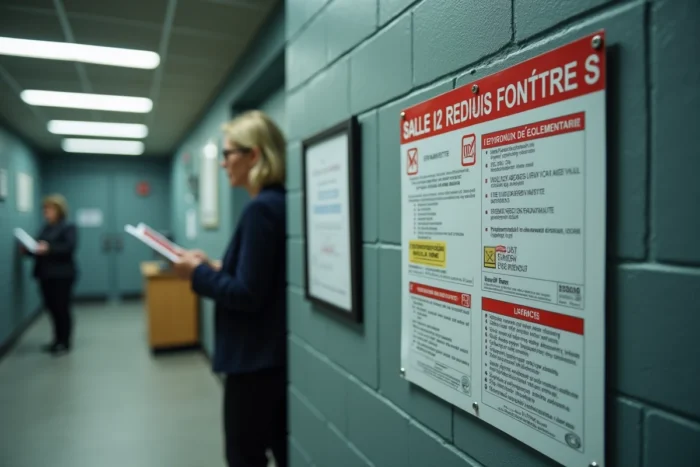
The rules for sizing exits are proportional to the audience size. We reason in terms of passage units: each unit corresponds to a standardized width allowing the flow of people. The number of emergency exits directly depends on the declared capacity.
A common mistake is to declare a reduced capacity to lighten obligations, then sell more tickets. The safety commission checks the consistency between the declared capacity, the number of installed seats, and the available exits.
Noise and accessibility obligations in performance venues
Beyond fire safety, two regulatory aspects weigh on venue operators: noise pollution and accessibility for people with disabilities.
Establishments broadcasting amplified music must comply with acoustic pressure thresholds and conduct a noise impact study. Non-compliance exposes them to administrative and criminal sanctions.
Regarding accessibility, performance venues must offer suitable locations for people with reduced mobility, as well as devices for hearing-impaired individuals. The installation of a hearing loop in the venue or at the ticket office is part of the expected equipment for higher category establishments.
- Accessible wheelchair spaces with an unobstructed view of the stage
- Hearing loop or listening assistance system in venues with significant capacity
- Accessible pathways from the entrance to the seats, restrooms, and emergency exits
Since 2025, the obligation to install an automated external defibrillator (AED) in certain ERP receiving the public is gradually expanding. Performance venues in categories 1 to 3 are subject to this obligation, in accordance with decree 2025-1167.
The compliance of a performance venue is not limited to a one-time submitted file. It requires ongoing monitoring: an updated safety register, periodic equipment checks, staff training for evacuation. The day the commission opens the door, it is the actual state of the venue that matters, not the initial file.