A general baccalaureate does not close any doors to interior architecture. The profession relies on the design of functional spaces, reading technical plans, and managing construction sites, skills that can be acquired in programs accessible after any general pathway, provided the right bridge is chosen.
Parallel admissions in interior architecture: the bridge that traditional programs do not show
Most guidance books present a linear path: high school diploma, then five years of study. This view masks a common mechanism in interior architecture schools: parallel admission in the 2nd or 3rd year based on a portfolio.
Some schools accept candidates who have already completed a bac+2 or started a bachelor’s degree in a related specialty (design, applied arts, layout). A student from a general pathway who has completed a first year of DN Made with a focus on space or a BTS related to layout can thus shorten their journey without starting from scratch.
The key lies in the portfolio. Parallel admission juries evaluate less the original diploma than the ability to produce sketches, manipulate volumes, and formulate a project intention. A candidate coming from a degree in art history, for example, has real chances if they present personal work demonstrating spatial sensitivity.
In practice, the approach to becoming an interior architect after a general pathway often follows this logic of progressive validation rather than a complete restart of the curriculum.
Expected digital skills: CAD, BIM, and visualization tools
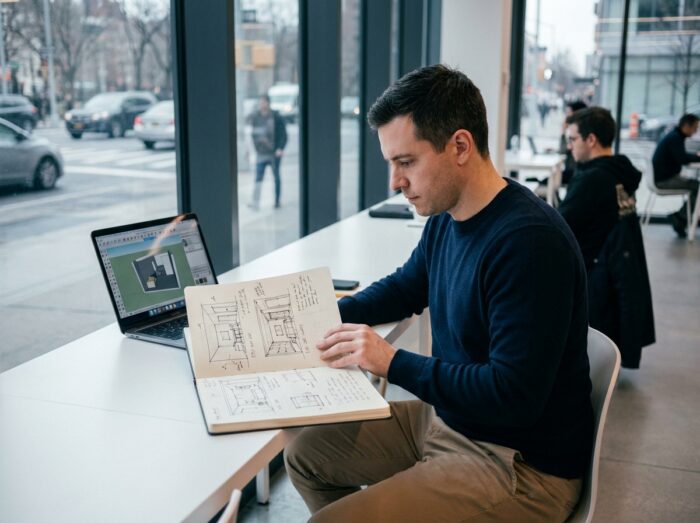
The profession has significantly evolved technically. Knowing how to draw by hand remains useful, but mastery of CAD and 3D rendering has become a prerequisite in most agencies.
Computer-aided design software allows for the production of dimensioned plans, sections, and elevations that can be utilized by construction companies. BIM (Building Information Modeling) goes further by integrating technical data, materials, and costs into a digital model shared among all project stakeholders.
For a profile coming from a general pathway, this digital dimension represents a paradoxical advantage. Students who took scientific or computer options in high school often adapt to these tools faster than purely artistic profiles. Some training programs now include modules on AI visualization tools, which accelerate the production of realistic renderings from rough sketches.
Three technical skills to acquire as a priority
- 3D modeling on professional software (SketchUp, Archicad, or Revit), which forms the basis of all exchanges with craftsmen and clients
- Reading and producing technical plans compliant with building standards, including identifying networks (electricity, plumbing, ventilation)
- Mastery of photorealistic rendering software to convincingly present projects to clients
Bac+3 diploma or bac+5 curriculum: what the market really expects
A distinction structures the job market in interior architecture. A bachelor’s degree (bac+3) opens up execution positions in agencies, while the complete management of a project, from design to construction oversight, generally requires a bac+5 level.
The title recognized by the CFAI (French Council of Interior Architects) or a diploma registered at RNCP level 7 remains the standard for practicing independently or managing complex projects. The difference between a Master’s degree (state diploma) and a Mastère (professional title) deserves attention: the latter is not a state diploma but a level 7 title registered with the RNCP.
For a profile coming from a general bac, two strategies work:
- Join a DN Made with a focus on space (three years), then continue in DSAA or DNSEP with a design option to reach bac+5 level
- Directly enroll in a five-year program at a private school offering a Mastère, ensuring that the title is certified RNCP
- Go through a BTS Study and realization of layout, which is more technical, before switching to a specialized school via parallel admission
Checks to make before enrolling
The RNCP certification of the school can be verified on the France Compétences website. An institution not listed in this directory does not issue a title recognized by the state, regardless of its commercial claims.
Professional labels and accreditations (recognition by the CFAI, partnerships with agencies for internships) serve as a second filter. A school without an active professional network significantly complicates job placement, even with a good diploma.

Funding and continuing education: mobilizable schemes
Career change or specialization towards interior architecture is now structured around RNCP certificates that can be funded via CPF. Short training programs, either in-person or online, allow for the acquisition of specific skill blocks without restarting a complete curriculum.
This intermediate path is suitable for profiles that already have some professional experience and wish to reposition themselves. The skill blocks acquired separately can, in some cases, be assembled to form a complete certification.
The choice between long training and modular training depends on a simple criterion: the type of project targeted. Working in an agency on design missions requires a solid curriculum. Working independently in decoration and layout consulting can be built with shorter training, provided one does not claim the title of interior architect without the corresponding certification.
The general baccalaureate, far from being a handicap, provides a general culture and analytical skills that the profession mobilizes daily, particularly in client relations and project management. The original pathway matters less than the quality of the portfolio and the certification obtained at the end of the chosen program.