
When an elderly relative needs a blood transfusion, the primary concern often revolves around possible reactions. The body of a person over 75 does not react the same way as that of a younger adult: the heart pumps less efficiently, the kidneys filter more slowly, and the immune system responds in a less predictable manner. These physiological particularities alter the nature and frequency of adverse effects.
Why the transfusion risk increases with age
Aging affects several organs simultaneously. A heart weakened by chronic heart failure poorly tolerates a rapid influx of blood volume. Less efficient kidneys struggle to eliminate excess fluid. These two combined factors create a conducive environment for circulatory overload.
Better understanding the side effects of a blood transfusion in elderly people involves this fundamental data: the body’s ability to adapt decreases with age. A volume of red blood cell concentrates well tolerated at 50 years old can cause pulmonary edema at 80.
The immune system also plays a role. After several transfusions over the years, the recipient may develop antibodies against certain antigens present on the donor’s red blood cells. This phenomenon, known as alloimmunization, complicates subsequent transfusions and necessitates searching for blood bags compatible with an increasingly demanding immune profile.
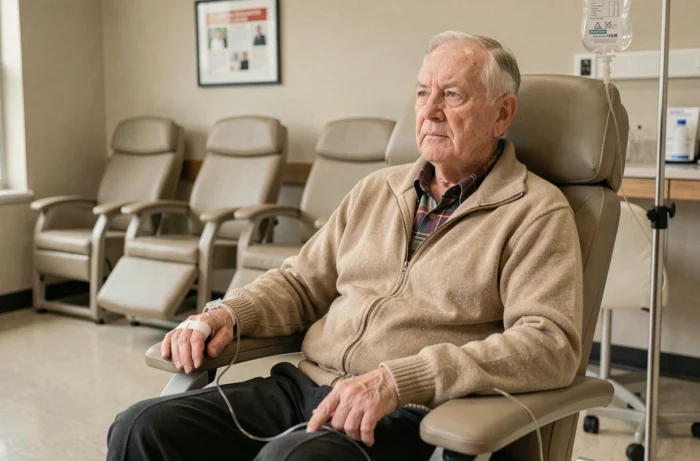
Post-transfusion circulatory overload (TACO): the major risk in the elderly
The circulatory overload associated with transfusion, referred to by the acronym TACO, represents the most feared complication in this age group. In practical terms, the heart receives more fluid than it can manage, and fluid accumulates in the lungs.
Signs often appear during the transfusion or in the hours that follow: sudden shortness of breath, cough, rising blood pressure, and sometimes a feeling of chest tightness. Have you ever noticed that an elderly relative gets short of breath more quickly when climbing stairs? The mechanism is similar but amplified by the additional blood volume.
How medical teams limit this risk
The infusion rate is systematically reduced for elderly patients. Instead of transfusing quickly, the care team adjusts the speed, sometimes administering only one red blood cell concentrate at a time rather than two. A diuretic may be prescribed between bags to help the kidneys eliminate the excess volume.
Monitoring during the first 15 minutes remains a critical moment. It is during this window that most severe reactions occur, regardless of type.
Febrile and allergic reactions after blood transfusion
The non-hemolytic febrile reaction is the most common complication across all ages. It manifests as a rise in temperature, chills, and sometimes shaking. In an elderly person, these symptoms can be confused with an infection, complicating the diagnosis.
A fever that appears during or just after the transfusion always necessitates immediate cessation of the procedure, while verifying that it is not a more serious reaction. In the majority of cases, the fever resolves within a few hours with symptomatic treatment.
Allergic reactions can range from simple hives to anaphylactic shock. In the elderly, anaphylactic shock is particularly dangerous because the cardiovascular system has less reserve to compensate for a drop in blood pressure.
- Non-hemolytic febrile reaction: chills, fever, shaking without destruction of red blood cells. Common but generally benign.
- Moderate allergic reaction: hives, itching, sometimes localized swelling. Treated with antihistamines.
- Anaphylactic shock: sudden drop in blood pressure, severe breathing difficulties. Rare, but requires emergency intervention.
- Acute hemolytic reaction: destruction of transfused red blood cells due to incompatibility. Extremely rare due to pre-transfusion checks, but potentially fatal.
Transfusion and cognitive disorders in the elderly
One aspect rarely addressed in information sheets concerns the link between transfusion and postoperative delirium. In elderly patients undergoing surgery, recurrent delirium (confusion, disorientation, agitation) has been associated with perioperative blood transfusion.
This delirium is correlated with a longer stay in intensive care and higher mortality. Transfusion is not merely a marker of patient severity: it is considered a modifiable exposure. In other words, limiting unnecessary transfusions could reduce the risk of postoperative confusion.
For families, this information changes the perspective. A transfusion is not a trivial “comfort” gesture: it is part of a risk-benefit calculation that the doctor evaluates on a case-by-case basis.
Restrictive transfusion strategy: transfusing less to protect better
The current medical trend favors lower trigger thresholds in elderly patients. Instead of transfusing as soon as the hemoglobin level drops below a generic threshold, the restrictive strategy adapts the decision to the overall clinical picture of the patient: anemia symptoms, cardiac status, exercise tolerance.
This approach is based on an observation: transfusing more does not necessarily improve prognosis. In some elderly patients, reducing the number of transfused bags decreases the risk of circulatory overload and immune complications without dangerously worsening anemia.
- The doctor evaluates symptoms (fatigue, shortness of breath, dizziness) and not just the hemoglobin level.
- Only one red blood cell concentrate is administered, followed by a new assessment before considering a second bag.
- The infusion rate is reduced, sometimes spread over several hours for a single concentrate.
A safety framework reinforced by hemovigilance
Hemovigilance procedures have significantly reduced risks over the years. The 2022 report from the National Institute of Public Health of Quebec indicates that the overall rate of transfusion reactions has decreased by about 37% between 2005 and 2022. Since the implementation of platelet safety measures in late 2015, no bacterial infection with certain liability has been reported on approximately 240,000 doses of platelets up to 2021.
The infectious risk related to blood itself is now very low in countries with an advanced safety system. Even though elderly individuals may accumulate several exposures (surgery, cancer, heart failure), this component of transfusion risk has significantly decreased.
Each transfusion in an elderly patient remains an individualized medical decision, weighed between the expected benefit on anemia and the risks specific to an aging body. The best protection comes from tailored prescriptions, close monitoring, and clear communication between the care team and the patient’s family.